FIRST IN VOTES, FAVORED TO LOSE: THE PACT TO DENY NIRAV SHAH MAINE'S DEMOCRATIC NOMINATION
Nirav Shah won the most first-choice votes in Maine's Democratic primary for governor. But the smart money says he loses the nomination anyway, to Hannah Pingree, undone by a three-way ranked-choice alliance.
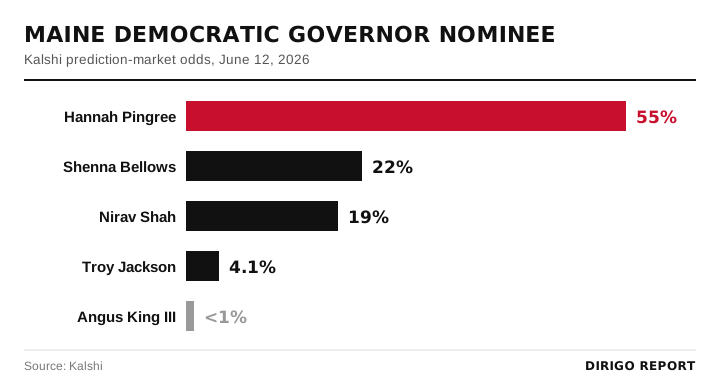
Nirav Shah, the former Maine and federal CDC official who led the polls all spring, finished first in Tuesday's five-way Democratic primary for governor, taking 26.9% of first-choice votes to former House Speaker Hannah Pingree's 23.3%. But no candidate cleared the 50% needed to win outright, so the nomination falls to a ranked-choice runoff that could take more than a week to finish, and the smart money is betting against the man who came in first. On Kalshi, a federally regulated prediction market where traders buy and sell contracts on how real-world events will turn out and a contract's price reflects the crowd's implied odds, Pingree is the clear favorite to win the nomination, at 55%; Shah, despite leading the first-choice vote, sits third on the market, at 19%, behind even Bellows.
The reason is an alliance built to stop him. On May 22, three of the five Democrats (Pingree, former Senate President Troy Jackson, and Secretary of State Shenna Bellows) announced they would rank one another ahead of the field, campaigned together, and openly isolated Shah. Their combined first-round share, roughly 65%, swamps his, and as the lowest finishers are eliminated and their ballots redistributed, those votes break toward Pingree, not Shah. A pre-election poll found most Bellows and Jackson voters ranked Pingree ahead of him, and the runoff tabulation has her on track to take the final round, by a margin of about 52% to 48%.
Strip away the mechanics and the result is striking: the candidate Maine Democrats ranked first is poised to be denied the nomination, not by the voters' first instinct, but by the coordination of three veteran officeholders and the math of the system they share. Angus King III, son of the U.S. senator, finished last and was eliminated first. Whoever emerges faces a Republican nominee, also headed to a ranked-choice runoff, plus at least one prominent independent in November.
Sources
- Portland Press Herald: Extremely close Maine Democratic governor primary headed to ranked-choice runoff
- NBC News: Maine's race for governor heads to ranked choice tallies in both primaries
- Maine Morning Star: Ranked choice voting will determine Maine's Democratic nominee for governor
- Kalshi: Maine Democratic Governor nominee? (prediction market)
- NBC News: Maine Governor primary live results